Anti-mosquito lasers, drones, or trap networks: how effective are these technologies in a garden?
With the increase and spread of mosquito populations, driven largely by climate change and shifting environmental conditions, mosquito-related nuisances are becoming an escalating concern.
Beyond repellent solutions and adult mosquito traps, new technologies are now seeking to target mosquitoes directly in flight. Autonomous drones, automated detection systems, and laser technologies are opening up new possibilities in the fight against adult mosquitoes.
However, these approaches operate on different principles. Between mobile intervention, individual neutralization, and continuous capture, the performance, constraints, and—most importantly—the level of maturity vary significantly. The goal of this comparison is to understand what these technologies can actually achieve today, their limitations, and their relevance in a residential setting.
Anti-mosquito drones: can they really target adults in flight?
Drones are already used in vector control to map areas, locate breeding sites, or apply specific treatments. A more recent approach involves developing small, autonomous drones capable of detecting, tracking, and then intercepting insects directly in flight.
The theoretical appeal is clear: the system no longer relies solely on attracting mosquitoes to a fixed point and can actively search for insects within a given area.
For garden use, however, this approach remains in its infancy. The latest prototypes have yet to demonstrate, in real-world outdoor conditions, their ability to selectively detect mosquitoes, operate autonomously, and maintain a sufficient interception rate over time.
Usage constrained by human presence
A flying device capable of pursuing and intercepting insects must operate in close proximity to people, animals, buildings, vegetation, and numerous obstacles.
Safety, battery life, noise, flight paths, and obstacle avoidance are therefore critical criteria for residential use. These constraints differ from those encountered by drones used occasionally for surveillance or treatment application.
They become even more significant if the drone carries an active neutralization mechanism other than physical interception of the insect.
Detecting females at the critical moment
The goal is not simply to kill mosquitoes. To reduce nuisance, the priority is to intercept females when they are actively searching for a host.
However, mosquito activity depends on the species, its activity cycle, and factors such as temperature, humidity, wind, and site layout. Activity peaks can concentrate a large number of host-seeking females over a short period.
The question then becomes one of actual interception throughput: can a mobile system detect and neutralize enough females during these periods to significantly reduce the nuisance?
Selectivity to be proven in real-world conditions
A garden is home to many flying insects. An automated system must therefore distinguish mosquitoes from other species to avoid unnecessarily targeting non-target insects.
Current projects are exploring acoustic signatures or wing-beat frequencies to identify targets. The performance of this classification in a vegetated environment, with multiple species and variable conditions, is a key challenge.
As of summer 2026, anti-mosquito micro-drone projects are in development and beginning to show demonstrations, but their autonomous and long-term effectiveness against mosquitoes in occupied gardens has yet to be documented by independent, real-world trials.
How does an anti-mosquito laser work?
Laser systems rely on a sophisticated principle: detecting an insect's passage, analyzing its trajectory and specific flight characteristics, and then automatically aiming a beam to neutralize the target.
The concept is no longer just theoretical. Published research has demonstrated the detection, tracking, and neutralization of insects in flight, including in experimental setups spanning several dozen meters. At the same time, new products are beginning to be announced or brought to market. However, this does not mean their effectiveness on the scale of a residential garden has been independently established yet.
To concretely evaluate this type of system, several questions remain essential:
- What area can actually be covered?
- How many mosquitoes can be neutralized under real-world conditions?
- Does the system effectively distinguish mosquitoes from other insects?
- How effective is it in dense vegetation?
- How can the safety of people and animals be guaranteed?
- Can it maintain a significant reduction in mosquito pressure over time?
Is an anti-mosquito laser safe for a garden?
Safety is a key criterion whenever a laser device operates in a frequented environment. The level of risk depends primarily on the wavelength, power, duration of exposure, and the safety features integrated into the system.
Experimental work on "photonic fences" specifically addresses this issue, with mechanisms designed to prevent firing when a person or animal is in the affected area.
In a residential setting, the presence of children, pets, reflective surfaces, or obstacles makes it necessary to examine not only the advertised performance but also the laser class, built-in safety features, and the exact conditions of use.
Equipment certification, safety testing, and, ideally, independent validation are therefore important criteria to consider before using such devices near living spaces.
The real challenge: sustainably reducing mosquito pressure
A common difficulty for technologies that neutralize mosquitoes individually is the constant replenishment of the population around a property.
Even if a large number of individuals are eliminated, new mosquitoes can emerge on-site or arrive from neighboring properties, gardens, hedges, and surrounding vegetated areas.
The question is therefore not just whether a technology can detect or kill a mosquito, but whether it has the capacity and continuity of action sufficient to sustainably reduce mosquito pressure for the occupants.
This is where the comparison with attractive traps becomes interesting.
The trap network: a logic of continuous capture
Attractant traps operate on a different principle. Rather than actively hunting down every mosquito, they create points of attraction and capture distributed around living areas.
Depending on the technology used, they may combine CO₂, olfactory attractants, suction, and mechanical capture. CO₂ in particular has long been used in monitoring devices to lure host-seeking females.
When used for protection, the goal is to intercept females before they reach people in the garden.
Why use multiple capture points?
A single trap inevitably has a limited range. Protecting a property therefore requires careful consideration of the placement of multiple traps based on:
- the surface area;
- the vegetation;
- living areas;
- refuge zones;
- potential mosquito entry points.
The network thus transforms several individual traps into a distributed and continuous capture system. However, its scale must be adapted to the site.
The limitations of trapping
Trapping is neither an instant nor a universal solution. Its performance depends on the attractants used, trap placement, vegetation, surrounding mosquito sources, and continuous operation. A network also requires a properly sized installation, consumables, and regular maintenance. Ultimately, its effectiveness is measured by its ability to sustainably and significantly reduce mosquito pressure in protected areas.
Three technologies, three philosophies
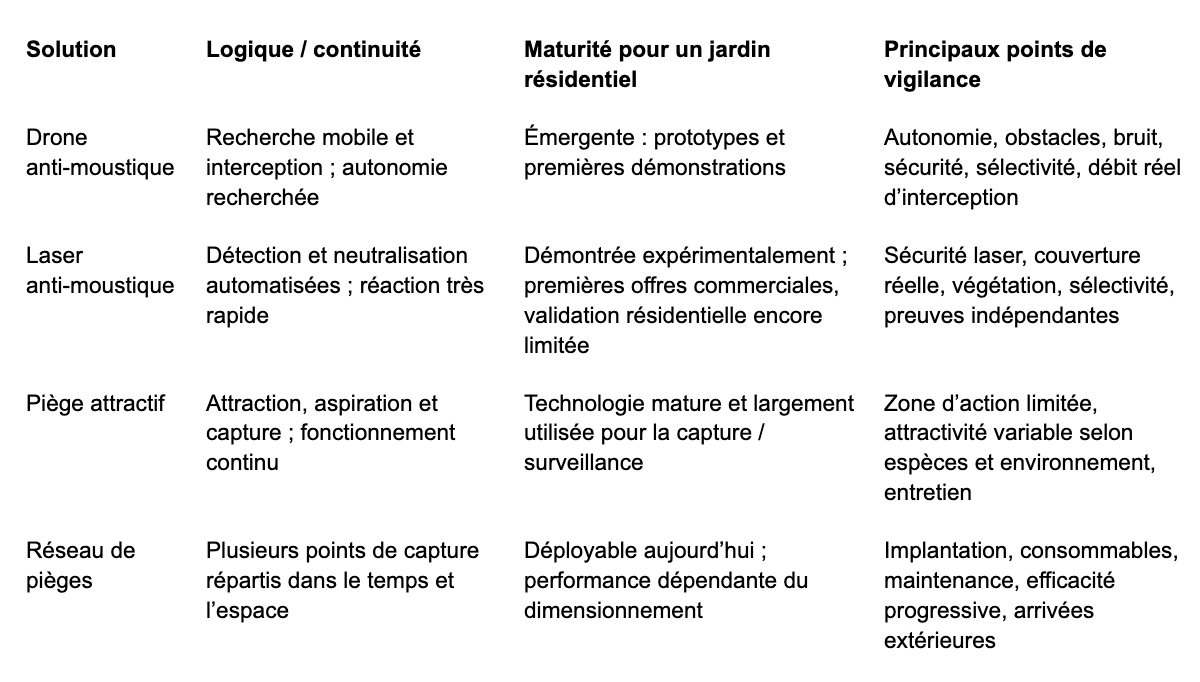
These technologies should not be compared solely on their sophistication. They differ primarily in their maturity, continuity of action, and the constraints they impose in a residential space.
A drone can actively search for mosquitoes. A laser can neutralize a detected target very quickly. A trap, on the other hand, can operate continuously for several weeks without needing to identify each insect individually. None of these features alone is sufficient to demonstrate a lasting reduction in nuisance.
Spectacular technology does not necessarily mean a comprehensive strategy
The performance of a technology is therefore not measured solely by the number of insects it can detect or neutralize during a demonstration.
For a residential property, you must also take into account:
- the actual area covered;
- the continuity of the action;
- the number of mosquitoes effectively neutralized or captured;
- mosquitoes arriving from outside;
- the safety of the occupants;
- selectivity regarding other insects;
- installation and maintenance constraints.
This framework helps place each technology in its true context: reducing mosquito pressure in areas where people live and enjoy their outdoor spaces, with an acceptable level of effort.
Why BioBelt chose a network-based approach
BioBelt has opted for this third approach: organizing multiple interception points around the areas to be protected rather than hunting down each mosquito individually.
The traps are positioned based on the property's layout, living areas, vegetation, and potential mosquito entry points, with the goal of intercepting females before they reach the occupants.
This approach prioritizes continuity: the capture points operate over time, and their performance depends on initial sizing, positioning, and regular maintenance.
This choice does not mean that laser or drone technologies lack merit. As they mature, they could complement or evolve mosquito control strategies. For now, BioBelt favors a capture technology that is already deployable in residential environments and organizes its effectiveness at the property scale through a network-based installation.
Conclusion: which technology should you choose today?
Drones and laser systems represent particularly interesting technological developments in the fight against adult mosquitoes. Lasers have already been scientifically demonstrated to detect and neutralize insects in flight; autonomous anti-mosquito micro-drones are at an earlier stage of development.
For residential use, their real value will depend on several factors: personal safety, selectivity, autonomy or processing capacity, area coverage, performance within vegetation, and validation of results in real-world conditions.
Attractant traps rely on more mature technology and a different philosophy: attracting and capturing continuously rather than hunting for each mosquito on an ad-hoc basis. However, their effectiveness is not automatic: it depends on the type of trap, its attractiveness, its placement, the network sizing, and its maintenance.
The drone searches and intervenes. The laser detects and neutralizes. The trap attracts and captures.
Beyond technological sophistication, the decisive criterion remains the same: a solution's proven ability to sustainably reduce mosquito pressure in living spaces throughout the entire period of use.
Sources and references
1. Keller M. D. et al., "Optical tracking and laser-induced mortality of insects during flight", Scientific Reports, 2020. Read the study
2. Centers for Disease Control and Prevention (CDC), "Mosquito Surveillance Traps": use of traps with attractants, notably CO₂, for capturing adult mosquitoes. Read the resource
3. Centers for Disease Control and Prevention (CDC), "Integrated Mosquito Management": mosquito control generally relies on a combination of methods adapted to the context. Read the resource
4. Tornyol / Y Combinator, development status reported in 2026 for an autonomous micro-drone designed to intercept mosquitoes. This source describes the manufacturer's project and does not constitute independent validation of its effectiveness. View project presentation
State of technologies and sources consulted in August 2026. Performance claims made by manufacturers are subject to change and should be distinguished from independently published or validated results.